Demond Melancon
Big Chief Demond Melancon invited to Biennale Arte 2026 by Koyo Kouoh
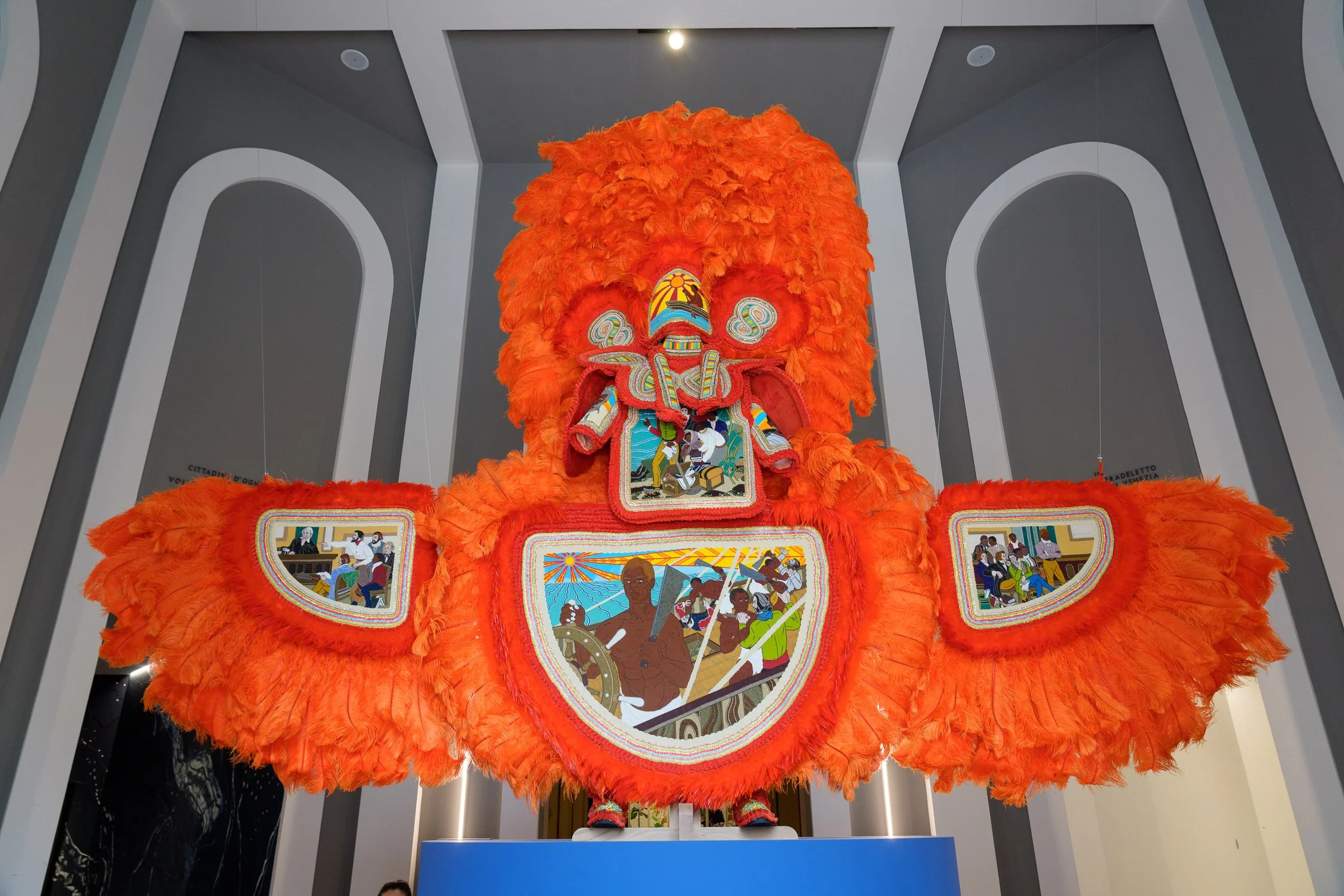
Installation view of Amistad Takeover, 2026. Photo by Andrea Avezzù. Courtesy of La Biennale di Venezia.
Venice Biennale
Biennale
La Biennale di Venezia
61st International Art Exhibition
Title
In Minor Keys
Artistic Director
Koyo Kouoh
Dates
May 9 - November 22, 2026
Invited Artist (International Exhibition)
Big Chief Demond Melancon
New Orleans, LA
International Exhibition Venues
Central Pavilion
Giardini della Biennale
Castello, 30122 Venezia
Corderie, Arsenale
Arsenale Campo della Tana 2169/f
Castello, 30122 Venezia
Organizer
Fondazione La Biennale di Venezia
Ca’ Giustinian, San Marco, Venezia
Official Website
www.labiennale.org
Big Chief Demond Melancon invited to the 61st International Art Exhibition of La Biennale di Venezia by Koyo Kouoh
The 61st International Art Exhibition of La Biennale di Venezia, In Minor Keys by Koyo Kouoh, – which runs from Saturday 9 May to Sunday 22 November 2026 at the Giardini, the Arsenale and in various locations around Venice. The pre-opening took place on May 6, 7, and 8, 2026.
After the premature passing of Koyo Kouoh in May 2025, with the full support of her family, La Biennale di Venezia decided to carry out her Exhibition, with the purpose of preserving, enhancing and widely disseminating her ideas and the work she pursued with such dedication to the very end. Koyo Kouoh, nominated as the Artistic Director of the Visual Arts Department in November 2024, already developed the curatorial project, defining its theoretical framework, selecting the artists and the artworks, designating the authors of the catalogue, determining the graphic identity of the Exhibition and the architecture of the exhibition spaces, and establishing a dialogue with the artists invited to participate.
In Minor Keys is the title chosen by Koyo Kouoh for the 61st International Art Exhibition, as specified in the curatorial text, which was sent to the President of La Biennale on 8 April 2025. The Exhibition has been realised with the contribution of the team selected by Koyo: Gabe Beckhurst Feijoo, Marie Hélène Pereira and Rasha Salti (advisors); Siddhartha Mitter (editor-in-chief); and Rory Tsapayi (research assistant).
Central Pavilion (Giardini): The Giardini della Biennale has been a central site for the Venice Biennale since 1895 and is home to nearly 30 permanent national pavilions and the Central Pavilion. The Central Pavilion is the main exhibition building in the Giardini della Biennale, hosting a core part of the international art exhibition curated by the artistic director. Photo Andrea Avezzu, Courtesy of La Biennale di Venezia.
During the presentation in Venice, at Ca’ Giustinian, headquarters of the La Biennale di Venezia, they were the ones who outlined the work carried out together with Koyo for the 61st International Art Exhibition. This work culminated in a significant meeting held in Dakar in April 2025 at RAW Material Company — the cultural center founded by Kouoh — and led by the Curator herself. That experience remains emblematic of the way she conceived curatorial practice: grounded in relationships and open to the unexpected.
“That week in Dakar – stated Koyo’s Team - was the edifying week that defined the 61st International Art Exhibition. We mapped practices and projects, we identified resonances, affinities, synchronicities and conversations, we extracted motifs to structure the exhibition and pillars on which to draw it. Notions like enchantment, seeding, commoning, and generative practices that invite collectivities, emerged organically. On the last day of our convention, after reckoning that we had accomplished the most daunting milestone, Koyo assigned missions to each of us. The exhibition had found its manifest forms, it was no longer intention, nor abstraction. We could hear the music she so gracefully composed with us, under the generous guardianship of the mango tree.”
Koyo’s Team, with members based in different cities around the world — Gabe in London, Marie Hélène between Dakar and Berlin, Rasha between Beirut and Marseille, Rory in Cape Town, and Siddhartha in New York City — has in recent months continued the work of producing the Exhibition, engaging La Biennale in a special effort during the project’s development phase, particularly the Visual Arts Department. Remote work through online meetings, combined with in-person seminars held in Venice in May and October 2025 and in Dakar in June 2025, enabled the Team to work alongside the Biennale while being distributed across several continents. This gave rise to an intense, multilayered, and deeply shared process, in which each contribution enriched the collective construction of the Exhibition.
The 61st International Art Exhibition of La Biennale di Venezia – In Minor Keys by Koyo Kouoh – runs from Saturday 9 May to Sunday 22 November 2026 (preview 6, 7, 8 May) at the Giardini and the Arsenale venues, and in various locations around Venice. With the full support of Koyo Kouoh’s family, La Biennale di Venezia decided to carry out her Exhibition. It has done so by following the project just as she conceived and defined it, with the purpose of preserving, enhancing and disseminating her ideas and the work she pursued.
In Minor Keys
In Minor Keys is the title chosen by Koyo Kouoh for the 61st International Art Exhibition, as specified in the curatorial text sent to the President of La Biennale on 8 April 2025. At that time, she wrote: “In October 2024, I was greatly honoured to be appointed curator of the 61st edition of Biennale Arte. It is with pleasure that I share today with you and your team the philosophical framework that will guide my curatorship of the exhibition.” The 61st Exhibition will be produced by La Biennale di Venezia, with the contribution of the professionals selected and directly involved by Koyo Kouoh. The team consists of the advisors Gabe Beckhurst Feijoo, Marie Helene Pereira and Rasha Salti; the editor-in-chief Siddhartha Mitter; and the assistant Rory Tsapayi. All the details of the project – including the list of artists invited to the International Exhibition, the graphic identity, the Exhibition design and the list of Participating Countries in the 61st Exhibition – was announced at the customary presentation held in Venice on Wednesday 25 February 2026. La Biennale di Venezia furthermore announces the beginning of a new collaboration with Bvlgari, which starting with the 61st edition will be the Exclusive Partner of the International Art Exhibition for three consecutive editions (2026, 2028, 2030). Founded in Rome in 1884, the High Jewellery Maison thus renews its commitment to support contemporary art, creative expression and the dialogue between different cultures, underscoring the value of art as a universal language.
Artist Director (Koyo Kouoh): Koyo Kouoh was appointed Artistic Director for the 61st Venice Biennale, making her the first African woman and the second African-born curator to helm the prestigious event. Following her sudden passing, La Biennale di Venezia committed to realizing the 2026 exhibition exactly as Kouoh conceived it, based on the comprehensive plans she finalized in early 2025. Photo by Mirjam Kluka.
The Exhibition by Koyo Kouoh
Artists. The 110 invited participants of this exhibition – among them, individual artists, collaborative duos, collectives, and artist-led organisations – hail from many geographies and regions selected by Koyo with particular attention to resonances, affinity, and and possible convergences between practices, even when far apart. In looking to artists working in Salvador, Dakar, San Juan, Beirut, Paris, or Nashville, for example, Koyo sought to envision how their ingenuity, breadth of material experimentation, and visionary ideas bear connections to other artists and movements in simultaneity. In this spirit, In Minor Keys expands upon Koyo’s relational geography of encounters with artists over her lifetime.
Motifs. Koyo saw several conceptual motifs guiding the exhibition. These were not abstractly determined but rather sifted from a reservoir of art that acts deeply on the soul and mind. They brought into focus a compositional method for the exhibition, which is not organised according to sections but rather in respect of undercurrent priorities. Among these are “Shrines” – in which prominence is given to the practices of two lodestar artists while exceeding a retrospective impulse; processional assemblies; enchantment in the face of cynicism about what art can do; spiritual and physical rest opened up by the oases – the keys or small islands of artists’ universes; and finally, Koyo’s commitment to artist-centred institution building or “Schools”, in which energy and resource is directed towards a social purpose.
Literary references. These strands leap from practice to practice, snaking an intergenerational path to build across the sites of In Minor Keys. During the curatorial work, many ideas resonated with the literary references shared by Koyo as sources of inspiration, among them, Beloved by Toni Morrison and One Hundred Years of Solitude by Gabriel García Márquez, texts that connect in their evocation of thresholds between lifeworlds and temporalities and by a magical realism which deepens rather than distracts from an emotional register.
Shrines. Sala Chini, which leads visitors to the core of the Central Pavilion, announces the vocabulary of the “Shrines”, which Koyo envisaged as tributes to two incandescent worldmakers: Issa Samb (1945–2017) and Beverly Buchanan (1940–2015). An artist, poet, playwright, and co-founder of the revolutionary collective Laboratoire Agit’Art in Dakar, Samb was an enduring presence, mentor, and inspiration for Koyo, who honoured his practice and life philosophy in international projects. Buchanan’s artmaking, which Koyo encountered more recently, encompassed subtle and confronting readings of locations and communities through anti-monumental approaches to Land Art and public sculpture, which she often placed in sites of charged memory. Both artists recognised the significance of art as generative, surpassing mere objecthood, and evading conventional preservation.
Procession. The procession’s motif, inspired by carnival choreographies and Afro-Atlantic gatherings, expresses a dynamic spacial language in which joining the crowd, rather than observing, is requisite and implied. In this carnivalesque dimension, capable of suspending and subverting hierarchies, many artistic practices challenge archives and canons, reinterpret established symbols, and demystify dominant narratives through transhistorical, speculative, or rigorous approaches.
Schools. The “Schools” emerge as ecosystems rooted in their local territories and, at the same time, transnational: spaces of learning and regeneration founded on encounter, shared knowledge, and autonomy from market forces. Integrated into the constellation of the exhibition, they reflect a shared ethic and a collaborative practice that intertwines art and social responsibility.
Rest. Themes such as the plantation, colonial settlement, environmental disaster, and geological memory traverse other works, which confront seismic events and their traces through radical and liberatory methods. At the same time, the Creole garden and the courtyard — spaces of self-sufficiency born under conditions of constraint — become both real and metaphorical places of rest, reconnection, and engagement with non-human forms of life. The Exhibition ultimately reflects on the possibility of stepping back from the encyclopedic impulse to make room for rest, contemplation, and deep listening. Multisensory installations encourage rêverie and enchantment, inviting visitors to slow down and allow themselves to be transformed by the experience. Through oases that evoke studios, courtyards, and learning spaces, In Minor Keys conveys the spirit of a project that weaves together collaboration, generosity, and trust in the multiple dimensions of our shared humanity.
Performances. The program of performances centres the body as a site of knowledge and memory, as well as a political vessel for collective resistance and healing. A procession of poets will take place in the Giardini della Biennale, inspired by Koyo’s Poetry Caravan, a voyage she undertook with nine African poets from Dakar to Timbuktu in 1999. The performance honours her memory and opens a space for poetry and storytelling. It pays homage to the griots those who seek the source human dream to spread the wings of knowledge and power. In the Giardini of La Biennale, poets will assemble to form a chorus vested with the power of the word, the groundswell of recital and spiritual healing.
Corderie (Arsenale): Measuring 317 meters long, the Corderie was built in 1303 and rebuilt in the late 16th century by Antonio da Ponte for the production of ship ropes and cables. After modern restoration and technological adaptation, it is now permanently dedicated to the curated international sections of both the Art and Architecture Biennales. Photo by Giulio Squillacciotti, Courtesy La Biennale di Venezia.
Acknowledgements
Big Chief Demond Melancon invited to the 61st International Art Exhibition of La Biennale di Venezia by Koyo Kouoh
This presentation is made possible through the principal support of The Helis Foundation. Major support is generously provided by Jeanne and Kevin Poorman, the Westridge Foundation, and New Orleans & Company, through the New Orleans Museum of Art Venice Biennale Support Initiative. Additional support is provided by generous donors to the Initiative. The New Orleans Museum of Art serves as fiscal sponsor of the NOMA Venice Biennale Support Initiative, supporting the participation of New Orleans artists invited to Biennale Arte 2026.
Additional institutional support is provided by Mariane Ibrahim Gallery. Produced with the support of Teiger Foundation, in partnership with American Friends of Zeitz MOCAA. Support for the performance programme of La Biennale di Venezia is provided by Ammodo.
We would like to thank the Ministry of Culture, the local Institutions that support La Biennale in various ways, the City of Venice, the Veneto Region, the Soprintendenza Archeologia, Belle Arti e Paesaggio per la città metropolitana di Venezia, and the Italian Navy.
We thank the important Donors, organizations and International institutions who are essentials to the realization of the 61st Exhibition.
With sincere gratitude, we thank Koyo Kouoh and her extraordinary team, who from the very beginning embraced the Curator’s vision with passion and generosity, contributing decisively to the creation and realization of the Exhibition.
Finally, we would also like thank the highly professional staff of La Biennale, who work with such great dedication on the organization and management of the Exhibition.
Strategic Advisor: David Gillin Favret
-
La Biennale di Venezia
61st International Art ExhibitionIN MINOR KEYS
[Take a deep breath]
[Exhale]
[Drop your shoulders]
[Close your eyes]This is an invitation to encounter these words in the immediate physical, meteorological, ambient, and karmic conditions in which they meet you. To shift to a slower gear and tune in to the frequencies of the minor keys. Because, though often lost in the anxious cacophony of the present chaos raging through the world, the music continues. The songs of those producing beauty in spite of tragedy, the tunes of the fugitives recovering from the ruins, the harmonies of those repairing wounds and worlds.
There is a reason, after all, that some people wish to colonize the moon, and others dance before it as an ancient friend. (James Baldwin, 1972)
The minor key, in music, alludes both to the structure of a song and to its emotional effects. It is a rich idea, so rich that it quickly overflows its technical definition and spills with metaphor. It summons moods, the blues, the call-and-response, the morna, the second line, the lament, the allegory, the whisper.
The minor keys refuse orchestral bombast and goose-step military marches and come alive in the quiet tones, the lower frequencies, the hums, the consolations of poetry, all portals of improvisation to the elsewhere and the otherwise. The minor keys ask for listening that calls on the emotions and sustains them in return.
The minor keys are also the small islands, worlds amid oceans with distinct and endlessly rich ecosystems, social lives that are articulated, for better and worse, within much larger political forms and ecological stakes. Here, the evocation of the key and the island extends to an archipelago of oases: gardens, courtyards, compounds, lofts, dance floors — the other worlds that artists make, the intimate and convivial universes that refresh and sustain even in terrible times; indeed, especially in terrible times.
Look at the creole garden, you put all species on such a little lick of land: avocados, lemons, yams, sugarcanes … plus thirty or forty other species on this bit of land that doesn’t go more than fifty feet up the side of the hill, they protect each other. In the great Circle, everything is in everything else. (Édouard Glissant, 2010)
These are the cues for an exhibition; an exhibition tuned in to the minor keys; an exhibition that invites listening to the persistent signals of earth and life, connecting to soul frequencies. If, in music, the minor keys are often associated with strangeness, melancholy and sorrow, here their joy, solace, hope, and transcendence manifest as well.
In the minor keys, sound and sensation are grounding, they hold the cadences, melodies, and silences of resonant worlds that gather and create together a polyphonous assembly of art, convening and communing in convivial collectivity, beaming across the void of alienation and the crackle of conflict.
The 61st edition of the Biennale Arte is grounded in a deep belief in artists as the vital interpreters of the social and psychic condition and catalysts of new relations and possibilities. The exhibition’s composition is formed by artistic practices that open portals, that refresh and nourish, that prompt relation and relationship, that advance concept and form through networks and schools — understood freely and informally.
The intended effect scrambles cohesion and dissonance in the manner of a free-jazz ensemble, or perhaps, at the scale of the Biennale Arte, a festival of ensembles with a common premise: that poetics liberate and people make beauty together.
Through, relation, sharing, and transcendence, the artists and practices that operate in this spirit, like jazz, across methods, scales, senses and forms, propose to visitors an exhibitional experience that is more sensory than didactic, renewing rather than exhausting, and fortifying for the work ahead.
Through a visual and meditative procession, the exhibition prompts all senses to interconnect and meander from one universe to the other, rendering visible the possibilities that reside in the in-between spaces and beyond the portals.
...there is no choice but to tune in like jazzmen to these imperative mutations. The jazzman constantly meditates on the unpredictable, stands within it according to the laws of polyrhythm, and improvises breathtaking moments. We small-island Caribbeans are not ready, but we have this resource. The change will have to be so profound that we will no doubt have to add to the knowledge of jazz, the old totemisms, animisms, analogisms, and other metaphysics too summarily discarded. These old-world poems are already precious scores. (Patrick Chamoiseau, 2023)
In this spirit, the international exhibition of the 61st Biennale Arte intends neither a litany of commentary on world events, nor an inattention or escape from compounding and continuous intersecting crises. Rather, it proposes a radical reconnection with art’s natural habitat and role in society: that is the emotional, the visual, the sensory, the affective, the subjective.
In Minor Keys are sequences of exhilarating journeys that address the sensate and the affective, inviting visitors to marvel, meditate, dream, revel, reflect, and commune in realms where time is not corporate property nor at the mercy of relentlessly accelerated productivity.
After all, it is clear by now that the enduring time of capital and empire maligned local, Indigenous and terrestrial knowledges as chimeric, and dismissed co-constitutive artistic practices as artisanal, intended for decoration or devotional rituals.
The ‘civilizing mission’ flattens all with condescending contempt, and in the contemporary era entire societies and ecologies are regarded as collateral damage in the headstrong pursuit of growth supported by ruthlessness and greed. In refusing the spectacle of horror, the time has come to listen to the minor keys, to tune in sotto voce to the whispers, to the lower frequencies; to find the oases, the islands, where the dignity of all living beings is safeguarded.
The exhibition posits that such radical shifts are taking place — indeed, have been underway all along — in the minor keys, and the artists, poets, performers, and filmmakers whom the exhibition will convene are grounded in their commitments to realizing them. Artists are channels to and between the minor keys and listening to, rather than speaking for them is at the core of the curatorial conceit.
The exhibition In Minor Keys stands as a collective score composed together with artists who have built universes of imagination. Artists who work at the boundaries of form, and whose practices can be thought of as intricate melodies to be heard both collectively and on their own terms. These are artists whose practices seamlessly bleed into society.
Artists who accommodate daily life as part of a logical and aesthetically consistent relation of parts. Artists who are exceedingly generous and hospitable to life.
In our myths, in our songs, that’s where the seeds are. It is not possible to constantly hone on the crisis. You have to have the love and you have to have the magic, that’s also life. (Toni Morrison, 1977)
-
La Biennale di Venezia was founded in 1895 and is now one of the most famous and prestigious cultural organizations in the world. La Biennale, who stands at the forefront of research and promotion of new contemporary art trends, organizes exhibitions and research in all its specific departments: Arts (1895), Architecture (1980), Cinema (1932), Dance (1999), Music (1930), and Theatre (1934). Its history is documented at the Historical Archives of Contemporary Arts (ASAC) that has been completely renovated in recent years.
Since 1998 the Art Biennale and the Architecture Biennale are no longer simply exhibitions organized with the contribution of National Pavilions, but rest instead on three pillars:
The exhibitions by National Pavilions, each with its own curator and project
The International Exhibition by the Biennale curator, chosen specifically for this task
Collateral Events, approved by the Biennale curator
This exhibition model has led to a pluralism of expressions: in order to accommodate them the exhibition spaces have grown for strategic needs, including an ambitious restoration of the Arsenale area which is still going on. The Art Biennale has been recognised as the world leader in contemporary art exhibitions and the countries participating have increased from 59 (in 1999) to 86 in 2017. The Architecture Biennale has also been recognised as the best in the world. The Venice International Film Festival at the Lido (the oldest in the world dating to 1932) has remained a prestigious event worldwide due to the quality of its selection and the recent refurbishing of its historic buildings and technological supplies.
The relationship with the local community has been strengthened through educational activities and guided visits, with the participation of a growing number of schools from the Veneto region and beyond. This spreads the creativity on the new generation (3,000 teachers and 30,000 pupils involved in 2014). These activities have been supported by the Venice Chamber of Commerce. A cooperation with Universities and research institutes making special tours and stays at the exhibitions has also been established. In the three years from 2012-2014, 227 universities (79 Italian and 148 international) have joined the Biennale Sessions project. In all sections there have been more research and production opportunities addressed to the younger generation of artists, directly in contact with recognised teachers; this has become more systematic and continuous through the international project Biennale College, now running in the Dance, Theatre, Music, and Cinema sections.
Exclusive Partner of the International Art Exhibition
BvlgariMain Sponsor of the Biennale Arte 2026
illycaffèSponsors
American Express
Bloomberg Philanthropies
Vela - Venezia Unica
Quattro Gatti Gin -
The 61st International Art Exhibition was also made possible thanks to the support of Bvulgari, Partner of the event.
Main Sponsor of the Exhibition is illycaffè.
Sponsor: American Express, Bloomberg Philanthropies, Vela-Venezia Unica and Quattro Gatti Gin.
La Biennale thanks Cleary Gottlieb Steen & Hamilton LLP.
Rai is Media Partner of the 61st International Art Exhibition and will follow the event with a dedicated offer on TV, radio and on the web.
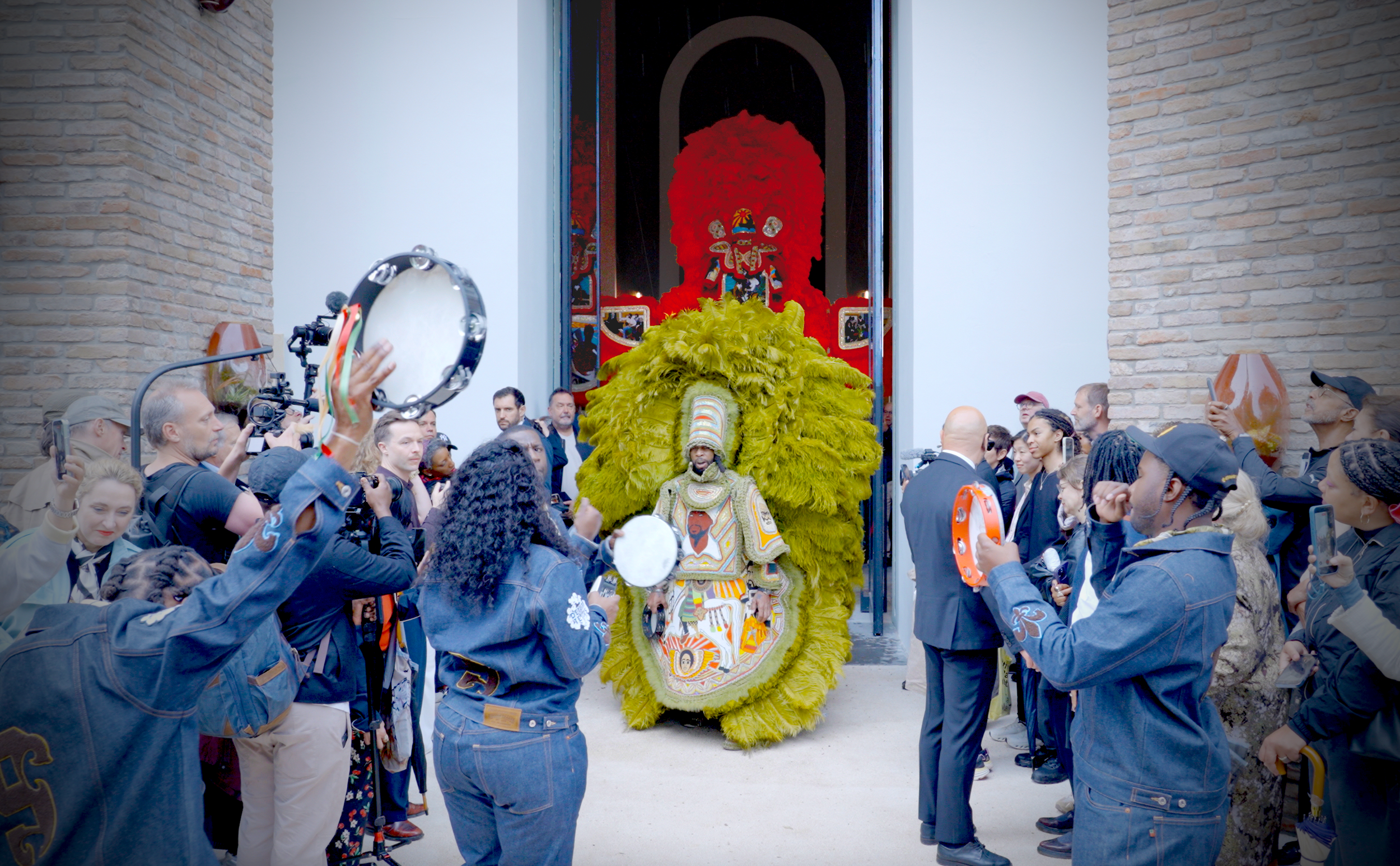
Blessing the Ancestors, Big Chief Demond Melancon and the Young Seminole Hunters, Biennale Arte 2026, Central Pavilion, Venice, Italy. Photo courtesy of Mariane Ibrahim Gallery.